Why Is My Period Late? Common Reasons and What to Do Next
Most late periods aren't serious. Here are the common reasons, when to take a pregnancy test, and when to see a doctor.

- Published
- Medical review
- Awaiting medical review by Dr. Ayesha Jawed
- Reading time
- 10 minutes
Quick answer
A late period is often caused by stress, weight change, too much exercise, hormone problems like Polycystic Ovary Syndrome (PCOS) or contraception. Breastfeeding, perimenopause (the years before periods stop) and pregnancy can cause it too. If you could be pregnant, test from the first day of the missed period. See a doctor if you've missed 3 periods in a row.
- The NHS says a late period isn't serious most of the time.
- Stress, weight change, too much exercise, PCOS and thyroid problems can all delay a period.
- If you could be pregnant, test from the first day of the missed period. Test again after a few days if it's negative.
- See a doctor if you've missed 3 periods in a row, or if your periods haven't started by age 15.
- Sharp sudden tummy pain with dizziness or fainting is an emergency. Go to the nearest hospital emergency.
Why is my period late?
Your period is often late because of stress, weight change, too much exercise, a hormone problem or hormonal contraception. Breastfeeding, pregnancy and perimenopause, the years before periods stop, can also make it late.
The National Health Service (NHS) in the UK lists these as the common causes. It also says that most of the time a late period isn't serious.
Here are the causes without pregnancy, or besides it, in groups. A delayed period (menstrual delay) is common, and the NHS says the gap between periods can just vary each time.
- Pregnancy. A missed period is often an early sign. Read more in the pregnancy section below.
- Stress. Stress and anxiety can delay a period.
- Weight and exercise. Sudden weight loss, being overweight and doing too much exercise can all do it.
- Hormones. Polycystic Ovary Syndrome (PCOS) and thyroid problems can delay periods. So can perimenopause, which usually starts between 45 and 55.
- Contraception. The combined pill, the contraceptive injection and the intrauterine system (IUS) can change your periods.
- Breastfeeding. The NHS lists it as a common cause.
Some health problems can also stop periods. The NHS names heart disease, diabetes, and an overactive or underactive thyroid.
How late is too late for a period?
See a doctor if you've missed 3 periods in a row. Your cycle length is the number of days between periods. A usual cycle is about 28 days, and a gap of 21 to 35 days is common.
A shorter or longer gap means your periods are irregular. Is it dangerous? Most of the time it isn't, says the NHS. But if your period keeps coming late, read our guide to irregular periods.
Speak to a doctor too if your normal pattern changes. The NHS pages on periods, irregular periods and missed or late periods give these numbers.
Period late and not sure why? Message us on WhatsApp at +92 334 2382368. Periods late hain? WhatsApp karein.
Could I be pregnant if my period is late?
Yes, you could be pregnant if you've missed a period and you've had sex. Pregnancy tests are most reliable from the first day of your missed period. A home test is accurate if you follow the instructions.
If you don't know when your period is due, test at least 21 days after unprotected sex.
A positive test is almost certainly right. A negative test is less reliable. Wait a few days and test again if you still think you could be pregnant. Hormonal contraception won't stop a test from working.
If your test is positive, you can work out your due date with our pregnancy due date calculator. You can read the early signs in our guide to pregnancy symptoms.
Why is my period late if I'm not married or I'm a teenager?
A period can be late for the same reasons in every girl and woman, whether she is married, unmarried, a virgin or a teenager. The NHS lists puberty, when periods first start, as a common cause of irregular periods.
If your periods haven't started by age 15, see a doctor. Read when girls usually get their first period for more.
Can stress, weight change or fasting delay a period?
Yes, stress, sudden weight loss, being overweight and doing too much exercise can all delay a period. MedlinePlus, a health site from the US National Library of Medicine, adds that severe anxiety makes missed periods more likely.
It says the same for long, hard exercise and for low body fat. It also lists sudden major weight loss, such as from an extreme diet.
Fasting isn't named as a cause on the pages we read. But a big change in food, sleep or weight can matter. Think about whether Ramadan, exam time or travel changed your routine. We haven't found a source that says fasting alone delays a period.
The NHS says a doctor can give advice on managing stress and keeping a healthy weight. MedlinePlus says changing your exercise or your weight may help if those are the cause.
Can PCOS or thyroid problems make a period late?
Yes, PCOS and thyroid problems can both make periods late or irregular. The NHS now calls PCOS by a new name, polyendocrine metabolic ovarian syndrome (PMOS), but most doctors in Pakistan still say PCOS.
The NHS says PCOS is a hormone condition that can affect hair growth, periods, fertility and mood.
The main signs of PCOS are:
- Irregular periods or long gaps between periods
- Extra hair growth on the face or body
- Weight gain, or trouble losing weight
- Oily skin and acne
- Feeling very tired
The NHS adds that you may be more likely to have PCOS if a close relative has it. The same is true if you're from an Asian background. You can read more in our guide on what is PCOS.
An overactive or underactive thyroid can also stop periods, according to the NHS. A doctor may do blood tests to find the cause. Treatment depends on the cause.
What should I do when my period is late?
Check your dates first. Then test if you could be pregnant. See a doctor if you've reached one of the limits in the next section.
- Count the days since your last period started, and work out how long your cycle usually is.
- Take a pregnancy test from the first day of the missed period if you could be pregnant. Test again after a few days if the first test is negative.
- Write down any other changes, such as weight gain or loss, tiredness, extra face hair, or dry or oily skin.
- Think about the last month. Did stress, food, sleep, exercise or weight change?
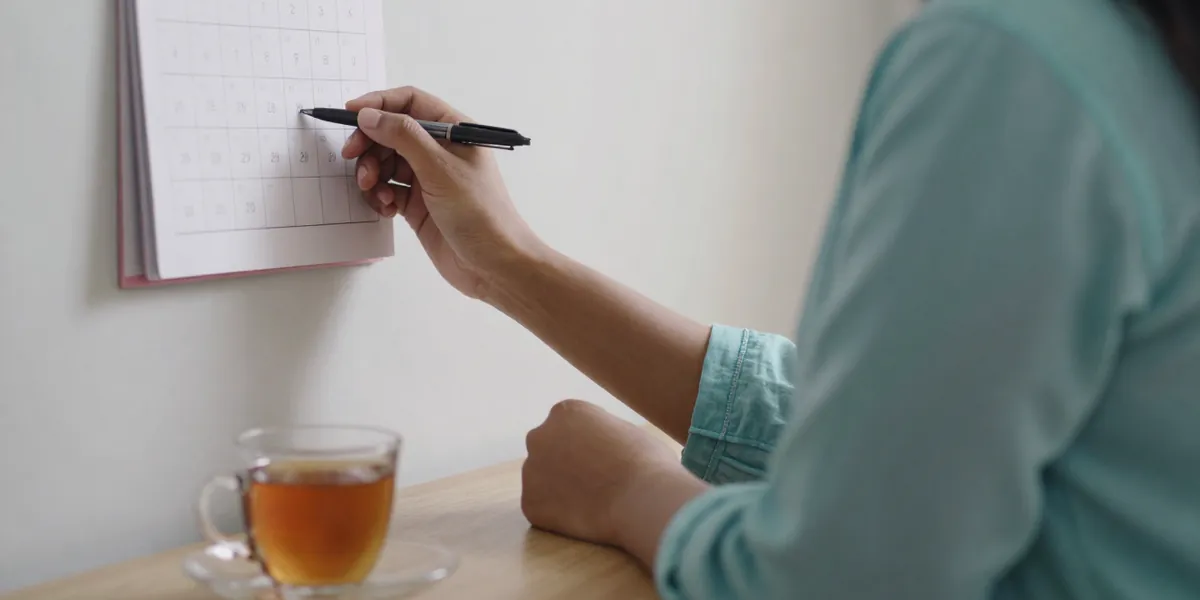
- Mark the first day of every period on a calendar from now on. A doctor can use these dates.
- See a doctor if you've missed 3 periods in a row, or your periods have become irregular.
Please ask a doctor before you take any medicine for your period.
When should I see a doctor about a late period?
See a doctor if you've missed 3 periods in a row or your periods haven't started by age 15. See one too if your periods have become irregular.
The NHS also says to see a doctor if you've missed a period and you have one of these signs:
- Weight gain or weight loss
- Tiredness
- Facial hair growth
- Dry or oily skin
Get your periods checked too if they last more than 7 days. The same goes for bleeding between periods or bleeding after sex. You should also go if you've had a negative pregnancy test and you've missed 3 periods in a row.
A doctor will ask about your health and may order blood tests. If you need more tests or scans, the NHS says you may be sent to a gynaecologist or an endocrinologist. An endocrinologist is a doctor for hormone problems.
When is a late period an emergency?
Go to the nearest hospital emergency now, or call Edhi on 115. Do this if you might be pregnant and have sudden, very strong tummy pain with dizziness or fainting, and don't wait for an online reply. The NHS says these signs can mean an ectopic pregnancy, so read the warning signs of a pregnancy outside the womb.
Periods late aane ki wajah kya hoti hai? (Roman Urdu mein)
Periods ka late hona aksar normal hota hai. Periods late aane ki wajah aksar stress, wazan mein tabdeeli, zyada exercise, hormones ka koi masla (jaise PCOS), contraception, breastfeeding, perimenopause ya pregnancy hoti hai.
Periods late hone ki waja kabhi kabhi thyroid ka masla ya doosri bimari bhi hoti hai. Aksar yeh serious nahi hota, lekin doctor ko dikhana behtar hai.
- Agar pregnancy ka imkaan ho, to period miss hone ke pehle din test karein.
- Agar test negative aaye, to kuch din baad dobara test karein.
- Lagatar 3 periods miss hon to doctor ko dikhayein.
- 15 saal ki umar tak periods shuru na hon to doctor ko dikhayein.
What can an online consult with Dr. Ayesha do for a late period?
An online consult can cover your history and symptoms, review your reports, give advice and plan the tests you may need. It can't do a physical exam or a procedure, and it can't handle an emergency.
If you need an exam or a test, Dr. Ayesha will tell you, and you will go to a hospital or lab in person.
Dr. Ayesha Jawed, MBBS, postgraduate trainee in Obstetrics and Gynaecology (CPSP), gives online consultations for Karachi Gynae. A consult costs Rs 499 for up to 1 hour. You can choose video, a call or WhatsApp on +92 334 2382368, Monday to Saturday, 9 am to 9 pm.
She reviews your reports, and you can share clear photos of them on WhatsApp. She can send a prescription when it's safe to do so online.
If your period is late and you want to talk it through, book an online consult.
Questions women ask
Why is my period late but the pregnancy test is negative?
A negative test is less reliable than a positive one, especially if you test too early. Wait a few days and test again. If it's still negative and your period hasn't come, see a doctor. Stress, weight change and hormone problems can also delay a period.
Is it normal for periods to be late after Ramadan or exams?
Periods can come early or late from one cycle to the next. The NHS lists stress as a common cause of a late period. We haven't found a source that names Ramadan fasting on its own. See a doctor if you've missed 3 periods in a row.
Can hormonal contraception make my period late?
Yes. The NHS names the combined pill, the contraceptive injection and the intrauterine system (IUS) as causes. MedlinePlus says periods can take more than 6 months to come back after you stop the pill or the injection. Talk to a doctor if you're worried.
Can breastfeeding delay my period?
Yes. The NHS and MedlinePlus both list breastfeeding as a common cause of a late or missed period. See a doctor if you've missed 3 periods in a row.
Are late periods normal sometimes?
Yes. The NHS says the gap between your periods may just vary each time. Most of the time it's nothing to worry about, but see a doctor if you've missed 3 periods in a row.
Does a late period mean something is seriously wrong?
Most of the time it doesn't, says the NHS. It still advises you to see a doctor about it just in case. Go to the doctor sooner if you've missed 3 periods in a row or you have other symptoms.
Periods late hon aur pregnancy test negative ho to kya karein?
Negative test kam bharosemand hota hai. Kuch din baad dobara test karein. Agar dobara negative aaye aur period phir bhi na aaye, to doctor ko dikhayein. Lagatar 3 periods miss hon to bhi doctor se milein.