 Guide
Bleeding in early pregnancy is common but can be serious.

Online consult across Pakistan
A plain guide for couples who've been trying for a baby. It covers when to see a doctor, the first tests for both partners, treatment options, IVF costs and what an online consult can do.
Book an online consult
Rs 499, up to 1 hour with Dr. Ayesha. Two quick steps.
Time with a female doctor
Up to 1 hour with Dr. Ayesha, by video, phone or WhatsApp.
Your reports reviewed
Share past tests, scans or prescriptions, and she'll go through them with you.
A clear plan
What to do next, and which tests may help.
A prescription when it's safe
If you need to be seen in person, she'll tell you plainly.
Quick answer
Infertility means a couple hasn't conceived after a year or more of regular unprotected sex, and it can affect men and women. Treatment starts with simple tests of ovulation, tubes, hormones and semen. The cause then decides the next step, from medicines to IVF.
See a doctor if you haven't conceived after a year of regular sex without contraception. The NHS says to go sooner if the woman is 36 or over, or if either of you knows of a problem.
The NHS says more than 8 out of 10 couples conceive naturally within a year if the woman is under 40. It also says around 1 in 7 couples may have difficulty conceiving.
The World Health Organization (WHO) uses the same 12-month line. It says about 1 in 6 people of reproductive age worldwide face infertility in their lifetime. The UK's newest guideline, NICE NG257 (31 March 2026), also uses 1 year, and 36 or over for earlier referral. The US CDC draws the line at 35: it says women 35 or older should see a provider after 6 months of trying.
Our guide on how to get pregnant fast covers timing and habits. Trying for a year or more? Message Dr. Ayesha to plan the first tests.
The NHS lists 4 common causes of infertility. They're ovulation that isn't regular, poor quality semen, blocked or damaged fallopian tubes, and endometriosis. The problem can be in the wife, the husband or both.
| Cause | What it means |
|---|---|
| Ovulation problems | The ovary doesn't release an egg each month. The NHS names PCOS, thyroid problems and the ovaries stopping before age 40. |
| Tube damage | The NHS says pelvic surgery and pelvic inflammatory disease can scar the tubes that link the ovaries to the womb. |
| Endometriosis | The NHS says it can damage the ovaries or tubes. |
| Fibroids | Non-cancerous growths in or around the womb can affect fertility, the NHS says. Read more on fibroids in the womb. |
| Semen quality | The NHS says poor quality semen is a common cause in men. |
The NHS also says unexplained infertility, where no cause is found, accounts for around 1 in 4 cases. It isn't anyone's fault.
Worried about family history? Our guide to cousin marriage and pregnancy explains what tests can and can't tell you.
Cleveland Clinic says the main sign is not getting pregnant, and you may have no other symptoms. Some people have pelvic or tummy pain, irregular periods or no periods. That's why tests come before any treatment.
Both partners are tested from the start, because the NHS says problems can affect either or both of you. The wife usually has hormone blood tests and a scan. The husband has a semen test.
The doctor first asks about your health, how long you've been trying and any past pregnancies. The NHS says they also ask about medicines, herbal remedies, smoking, weight, alcohol and stress.
Our guide to infertility tests for women explains each test in order, what it involves and whether it hurts.
A 2025 Dawn report described a widespread belief, even within whole families, that infertility is solely a woman's issue. A doctor in the report said men often hesitate to be tested because of stigma. Testing both of you early saves months of guessing.
They're tested because both can stop ovulation. The NHS says an overactive or underactive thyroid can prevent it. MedlinePlus says high prolactin, a hormone from the pituitary gland, can cause period problems and infertility.
MedlinePlus says high prolactin can also cause breast milk when you aren't pregnant or breastfeeding.
These are simple blood tests done at a lab. Any medicine is the doctor's decision, so we don't list drug names or doses here.
A semen analysis is a lab test of the amount and quality of semen and sperm. It's done early because the European Association of Urology (EAU) finds a male factor in about 50% of infertile couples.
The EAU says a male cause alone is found in about 20% of couples. So the test is about facts, not blame. The WHO notes that women are often seen as the infertile partner, whether they are or not.
Labs compare results with the lower reference limits (fifth centiles) in the WHO manual's sixth edition (2021), as listed in the EAU guideline.
| Item on the report | WHO 2021 lower limit |
|---|---|
| Semen volume | 1.4 mL |
| Total sperm number | 39 million per sample |
| Sperm concentration | 16 million per mL |
| Total motility (sperm that move) | 42% |
| Progressive motility (sperm that swim forward) | 30% |
| Vitality (sperm that are alive) | 54% |
| Normal shape (morphology) | 4% |
These are lower limits, not pass marks. The EAU says they don't mark a line between fertile and infertile men. Older reports may use the 2010 edition, so check the range printed on your own report.
One report isn't a verdict. The EAU advises at least 2 semen tests in a row if the first is abnormal. MedlinePlus says an abnormal result doesn't mean a man is permanently infertile.
A man's own health condition needs a doctor who treats men. Dr. Ayesha consults women, but she can go through both reports with the couple and explain the next step.
The NHS lists 3 main types of fertility treatment: medicines, surgery and assisted conception. Assisted conception includes intrauterine insemination (IUI) and in vitro fertilisation (IVF). The right one depends on what your tests find.
It depends on what the tests show, your age and how long you've been trying. A doctor who has seen all your reports can tell you if a referral makes sense.
Dr. Ayesha doesn't do IVF or any procedure. She helps you finish the first tests, then talks through when a fertility centre is a sensible next step. This page doesn't name any centre.
The NHS says there's no evidence that complementary therapies for fertility problems work. Tell your doctor about any desi or herbal medicine you've taken. Be wary of anyone who promises a baby.
Each centre sets its own IVF price per cycle. On 11 May 2025, Dawn reported costs of Rs 600,000 at private clinics and Rs 200,000 to 350,000 at public centres. Today's prices may differ.
The same report said patients at the Sindh Reproductive and Genetic Health Centre still paid for medicines, typically Rs 100,000 to 150,000. One woman said she spent more than Rs 1 million on tests, scans, drugs and procedures.
These figures are from one news report and aren't Dr. Ayesha's prices, because she doesn't do IVF. Always ask the centre for a written, dated quote.
The NHS says a full IVF cycle takes around 3 to 6 weeks. It includes medicines, scans, egg collection, lab work and embryo transfer. Each step adds cost, and clinics should tell you about extras such as embryo storage.
Ask every centre these questions before you pay:
No. The NHS says your chance depends on age, the cause of the problem, body mass index (BMI), smoking and drinking. Be careful with any centre that promises a fixed success rate.
The NHS also lists risks: too many eggs in the ovaries, twins or more, and a pregnancy outside the womb.
This page covers treatment with the husband's and wife's own eggs and sperm only. For religious questions about any fertility treatment, please ask a scholar you trust.
Ask a doctor about the cheaper steps that come first. These include the semen test, ovulation and tube checks, and treating PCOS or thyroid problems.
PCOS can make it harder to get pregnant because it can stop regular ovulation. The NHS lists it among the ovulation problems behind infertility. But having PCOS doesn't mean you can't conceive.
The NHS renamed it polyendocrine metabolic ovarian syndrome (PMOS) in 2026. Most people in Pakistan still say PCOS. Our guide on getting pregnant with PCOS covers what helps and when to see a doctor.
Talk about it as a couple, get tested together and ask for help early. The WHO says the burden falls heavily on women, who often face stigma, divorce or violence.
MedlinePlus says the tests and treatment are stressful for most couples. They can bring depression, anger, anxiety and marriage problems. You're not weak for feeling this way.
Share results with each other first, and decide together what to tell family.
If you've already had a child, our guide on secondary infertility covers that pressure too.
Please see a doctor in person soon if low mood lasts for weeks or you think about harming yourself. In an emergency, go to the nearest hospital emergency now or call Edhi on 115.
An online consult covers your history, your cycle and your past reports. It also plans which tests to do first. The wife can come alone, or both of you can join together.
The consult is with Dr. Ayesha Jawed, MBBS, postgraduate trainee in Obstetrics and Gynaecology (CPSP).
What she can do online: give advice and follow up with you. She reviews your reports, and you can share clear photos of them on WhatsApp. She can send a prescription when it's safe to do so online.
What she can't do online: any physical exam, scan, procedure or IVF. Blood tests, semen tests and scans are done at a lab or hospital.
If you need an exam, she'll tell you where to go in person.
What to bring to the consult:
Emergency: the NHS says sudden, sharp and intense tummy pain with dizziness or fainting can mean a pregnancy outside the womb. Go to the nearest hospital emergency or call Edhi on 115. Don't wait for an online reply.
Booking takes 3 steps: message on WhatsApp, pick a time, then talk by video, call or WhatsApp. A consult costs Rs 499 for up to 1 hour. Hours are Monday to Saturday, 9 am to 9 pm.
You can read how our online consults work, and see the other women's health services we offer online.
Four simple steps from your first message to your plan. It's the same for every topic.
Message on WhatsApp
Send a message to +92 334 2382368, or use the form on this page.
Pick a time
Choose a time from Monday to Saturday, 9 am to 9 pm.
Talk by video, phone or WhatsApp
Talk to Dr. Ayesha for up to 1 hour, in the way that suits you.
Get your plan
Leave with clear next steps, and a prescription when it's safe.
She reviews reports you share.
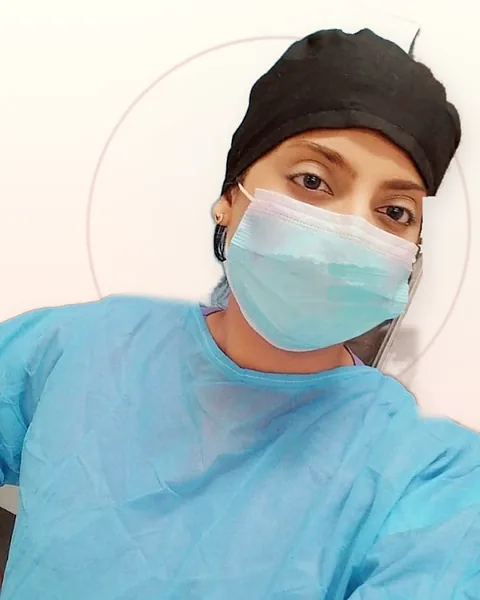
Dr. Ayesha Jawed, MBBS, training in Obstetrics and Gynaecology (CPSP)
PMDC 113388-P. PMDC lists her as Ayesha Javaid. How to check a doctor's registration.
Rs 499per consult, up to 1 hour
Pay by JazzCash, Easypaisa or bank transfer. See fees and payment.
Something else on your mind? WhatsApp +92 334 2382368, Monday to Saturday, 9 am to 9 pm.
The NHS says to see a doctor after a year of trying. Go sooner if the woman is 36 or over, or if either of you already knows of a fertility problem. The CDC says women 35 or older should go after 6 months.
No. The NHS says fertility problems can affect either partner, and the EAU finds a male factor in about half of infertile couples. That's why the husband's semen test is one of the first tests.
Not always. The NHS lists medicines and surgery as treatments too. A doctor looks at all your results, your age and how long you've been trying before IVF is suggested.
Yes. Dr. Ayesha can see the wife alone or both of you together online. The husband's semen test is still needed, and you can bring his report to a later consult.
She can send a prescription when it's safe to do so online. Fertility medicines need tests and follow-up first, so she'll plan the tests before any medicine is discussed.
Agar ek saal se koshish kar rahe hain aur hamal nahi thehra, to doctor ko dikhayein. NHS ke mutabiq agar biwi ki umar 36 saal ya us se zyada hai to pehle dikhayein. CDC ke mutabiq 35 saal ya zyada umar ho to 6 mahine baad dikhayein.
Dono ka. Masla biwi, shohar ya dono mein ho sakta hai, is liye dono ka test hota hai. Shohar ka semen test asaan hai aur shuru mein hi karwana chahiye.
Biwi ke hormone blood tests aur scan, aur shohar ka semen analysis. Doctor pehle aap ki history poochhti hain aur phir batati hain ke kaun se tests zaroori hain.
PCOS mein ovulation regular nahi hoti, is liye hamal mein zyada waqt lag sakta hai. Lekin PCOS ka matlab yeh nahi ke aap pregnant nahi ho sakti.
GuideBleeding in early pregnancy is common but can be serious.
 Service
C section delivery: why it's done, planned or emergency, anaesthesia, risks and Pakistan's rising rates.
 Guide
Cervical cancer symptoms explained: unusual bleeding, discharge changes and pelvic pain, what else they can mean, and when to see a doctor.
 Fertility
No method gives a guaranteed pregnancy, but timing and healthy habits help. Here's what the evidence says, and when to see a doctor.
 Fertility
Here are the tests doctors use for female infertility, what each one checks, when it's done, and why your husband needs a test too.
 PCOS
Many women with PCOS do get pregnant, though it can take longer. Here's why, what to try first, when to see a doctor and what treatment may help.
 Fertility
Trouble conceiving after your first baby is not rare, and it has reasons. Here are the causes, the tests, and when to ask for help.
Awaiting medical review by Dr. Ayesha Jawed. Written from the sources listed here. General information, not a diagnosis.
Last updated 19 November 2026
Dr. Ayesha JawedMBBS, training in Obstetrics and Gynaecology (CPSP)
Online consult, Rs 499, up to 1 hour. Private, from home, anywhere in Pakistan. Fill in two short steps and WhatsApp opens with your details ready.
Book your consult
Rs 499, up to 1 hour with Dr. Ayesha. Two quick steps.
In an emergency, go to the nearest hospital or call Edhi 115.
This page is coming soon.