Spotting Between Periods: Common Causes and When to Get It Checked
Light bleeding between periods is often harmless. Here are the usual causes, which ones need a check, and what to do first.

- Published
- Medical review
- Awaiting medical review by Dr. Ayesha Jawed
- Reading time
- 11 minutes
Quick answer
Spotting between periods is often harmless, such as ovulation or a change in contraception. Get it checked if it has no clear reason, keeps happening, happens after sex, or comes with pain or a fever. Test for pregnancy if you could be pregnant, and message a doctor early.
- Ovulation spotting is light and usually lasts 1 to 2 days.
- A usual period lasts about 5 days, so bleeding on other days stands out.
- The NHS says bleeding between periods and bleeding after sex should be checked by a doctor.
- If you could be pregnant, take a pregnancy test.
- Sudden strong tummy pain with dizziness or fainting is an emergency. Go to the nearest hospital emergency or call Edhi on 115.
What is spotting between periods?
Spotting between periods is a little blood on days when you aren't expecting your next period. Doctors also call it light bleeding between periods or intermenstrual bleeding. It's much lighter than a period.
A usual period lasts about 5 days. Anywhere from 2 to 7 days is common. A usual cycle is 21 to 35 days long. The National Health Service (NHS) in the UK gives these numbers.
Ovulation is when an ovary releases an egg. It usually happens about halfway between two periods. In a 28-day cycle that's around day 14. Light bleeding around that time is called mid-cycle spotting. It's one possible cause.
If the stain is brown and you aren't sure it's bleeding at all, read what brown stains mean.
How much spotting is normal, and what does it look like?
Ovulation spotting is the most harmless kind. It's light and lasts a day or two. It's often too little to fill a tampon. It's usually pink or light red, though it can look brown.
| Ovulation spotting | A period | |
|---|---|---|
| How long | Usually 1 to 2 days | About 5 days, and 2 to 7 days is common |
| How much | Light, often too little to fill a tampon | Most women lose about 20 to 90 ml in total, heaviest in the first 2 days |
| When it comes | Around the middle of the cycle | Once in each cycle |
We didn't find one amount that is "normal" for every cause of spotting. Cleveland Clinic says bleeding that is new, irregular or unexplained should be checked, even when ovulation is the likely reason.
What are the common causes of spotting between periods?
Common causes of spotting between periods are ovulation, contraception changes, an intrauterine device (IUD), stress and infection. Polyps, thyroid problems, Polycystic Ovary Syndrome (PCOS) and pregnancy can cause it too. MedlinePlus says most causes can be treated.
| Cause | What can happen | When to get it checked |
|---|---|---|
| Ovulation | Estrogen drops after the egg is released. A little of the womb lining sheds. About 8 in 100 women have this spotting, says Cleveland Clinic. | If it's new, irregular or unexplained |
| Hormonal contraception | MedlinePlus lists uneven use of hormonal birth control as a cause. The NHS says three methods can change your periods. They are the progestogen-only pill (a pill with just one hormone), the contraceptive injection and the intrauterine system (IUS). | Tell your doctor. Don't stop or change a method on your own |
| An IUD, such as a copper coil | MedlinePlus says an IUD can cause occasional spotting. The NHS says you may have some bleeding between periods after one is fitted. | Get an urgent appointment for tummy pain that painkillers don't ease, fever, smelly discharge or very heavy bleeding. Pelvic infections usually happen within 3 weeks of fitting. |
| Stress, weight change or too much exercise | The NHS lists all three as causes of irregular periods. MedlinePlus lists stress as a cause of bleeding between periods. | If it keeps happening |
| Infection | Chlamydia can cause spotting between periods and bleeding after sex. Cleveland Clinic also lists yeast infections and bacterial vaginosis. Many people with chlamydia have no symptoms. | Yes, a test is needed. It's done at a lab or hospital |
| Polyps and fibroids | These are growths in the womb or on the cervix, the neck of the womb. | Yes, see a doctor |
| Thyroid problems or PCOS | MedlinePlus lists low thyroid function as a cause. The NHS says thyroid problems and PCOS can make periods irregular. | If your cycle is also off |
| Pregnancy problems | MedlinePlus lists ectopic pregnancy and miscarriage. | Test if you could be pregnant, and read the emergency advice below |
The NHS now calls PCOS "polyendocrine metabolic ovarian syndrome" (PMOS). We use PCOS because most women know that name.
MedlinePlus also lists blood-thinning medicines. Tell your doctor about every medicine you take. Don't stop one on your own.
Spotting can also happen in pregnancy, so take a pregnancy test if you could be pregnant. Our guide explains when to test and when to test again.
Spotting for more than one cycle? Message Dr. Ayesha on WhatsApp at +92 334 2382368 with the date your last period started.
If your cycle length keeps changing too, read our guide on when your cycle keeps changing.
When is spotting between periods a reason to see a doctor?
See a doctor if spotting has no clear reason, keeps coming back or happens after sex. The NHS says bleeding between periods needs checking. The sources we read don't give a safe number of cycles to wait.
Get it checked sooner if you have any of these.
- Bleeding after sex. The NHS lists bleeding during or after sex, or between periods, as symptoms to get checked.
- Spotting with pelvic pain, tiredness or dizziness, says MedlinePlus.
- Unusual discharge, lower tummy pain or burning when you pass urine. The NHS lists these with chlamydia.
- Heavy bleeding. The NHS says signs include changing a pad every hour or two, clots over 2.5 cm, or bleeding for longer than 7 days.
- A positive pregnancy test, or a chance that you're pregnant.
- Any bleeding after menopause.
The NHS says these symptoms have many causes, and having them doesn't mean you have cancer. It also says early checks matter. The NHS says bleeding between periods or after sex can sometimes be a sign of cancer. MedlinePlus says the same, so don't ignore it.
When can spotting be an emergency?
Go to the nearest hospital emergency now, or call Edhi on 115. Do this for heavy bleeding with dizziness or severe pain, or any bleeding if you could be pregnant, and don't wait for an online reply. The NHS says these signs can mean an ectopic pregnancy, so read the warning signs of a pregnancy outside the womb.
What tests will the doctor suggest?
A doctor may suggest a pregnancy test, blood tests, swabs for infection, a pelvic ultrasound scan or cervical screening, depending on your age and symptoms. MedlinePlus lists these tests, and a few more that are used only when needed.
- Pregnancy test. This is often the first step if you could be pregnant.
- Blood tests. MedlinePlus says these can check thyroid and ovary hormones. The NHS says blood tests can also check for low iron after heavy bleeding.
- Swabs. These check the cervix for infections.
- Ultrasound scan. This looks at the womb for polyps and fibroids.
- Cervical screening. A doctor will tell you if you're due.
Dr. Ayesha can't do an exam, a swab or a scan online. If you need one, she'll tell you, and you'll go to a hospital or lab in person. She then reads the result with you online and plans the next step.
Can unmarried girls and teens have spotting?
Yes, girls and women of any age can have spotting, married or not. There's nothing to be ashamed of when you ask a doctor for help.
A cycle that's still settling is one possible reason, because the NHS lists puberty as a cause of irregular periods.
Periods usually start around age 12. The NHS says most girls have regular periods by age 16 to 18.
A pregnancy test is only needed if you could be pregnant. You can write on WhatsApp in your own words, and your message stays private. No exam is done online.
If bleeding is heavy, painful or happens often, don't wait to see if it settles. Message a doctor.
What can I do while waiting for my appointment?
While you wait, write down your dates and what you see. Don't take hormone medicine on your own. Note your contraception and any recent changes.
A short record helps a doctor find the cause faster. Healthdirect Australia says a doctor will ask when the bleeding happens, how often, how heavy it is and how long it lasts.
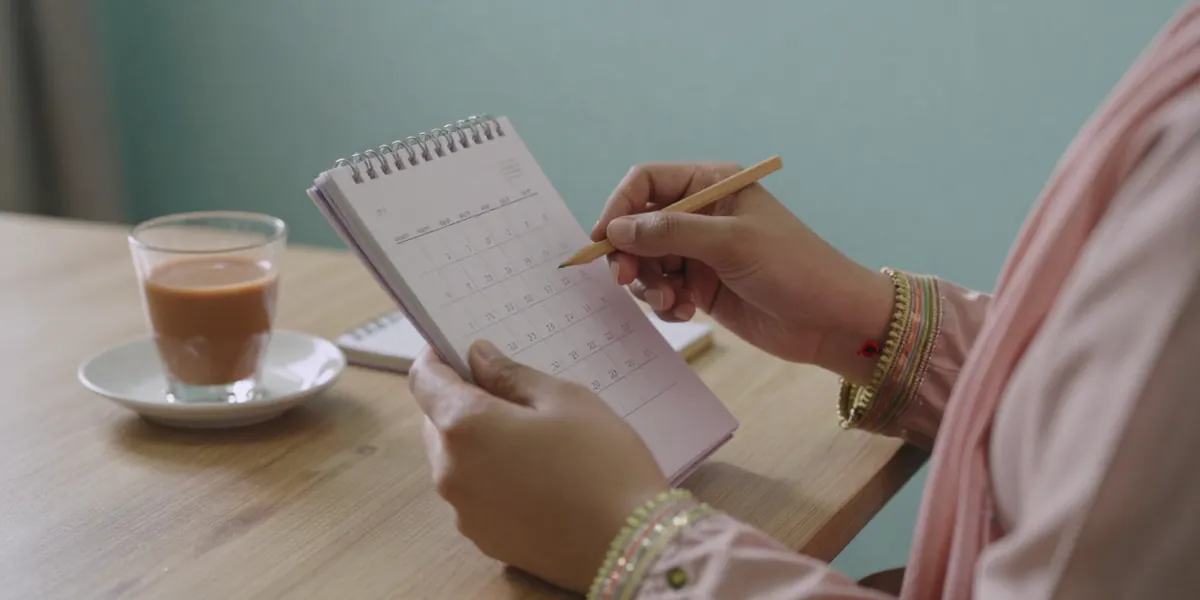
- Track your cycle. Write the date each spot of blood appears, and the first day of your last period.
- Count the pads or tampons you use each day. MedlinePlus says this helps estimate blood loss.
- Note the colour and whether you have pain, burning, fever or unusual discharge.
- List your medicines and your contraception, and the date of any change.
- Take a pregnancy test if you could be pregnant.
Please don't start, stop or change a hormone medicine without advice. MedlinePlus says aspirin may make bleeding last longer, so ask before you use it.
If you want to talk it through, book an online consult.
Periods ke beech mein spotting kyun hoti hai? (Roman Urdu mein)
Ovulation (andey ka nikalna) ke waqt halki spotting ho sakti hai. Periods ke beech mein spotting aksar kai wajahon se hoti hai, jaise ovulation, contraception mein tabdeeli, IUD, stress, infection, polyp, thyroid ya PCOS aur pregnancy.
Wajah janne ke liye doctor se check karwana behtar hai.
- Agar pregnancy ka imkaan ho to test karein.
- Spotting sex ke baad ho, baar baar ho ya bina wajah ho to doctor ko dikhayein.
- Tez dard, chakkar ya behoshi ho to foran qareebi hospital ki emergency mein jayein ya Edhi 115 par call karein.
- Apni dates aur khoon ki miqdar likh lein.
What can an online consult with Dr. Ayesha do for spotting?
An online consult can cover your history and symptoms, review your reports and scans, give advice, plan your tests and follow up with you afterwards. It can't do a physical exam or a procedure, and it can't handle an emergency.
Spotting often needs an exam, a swab or a scan in person at a hospital or lab. Dr. Ayesha advises on the plan and reads the result with you online.
Dr. Ayesha Jawed, MBBS, postgraduate trainee in Obstetrics and Gynaecology (CPSP), gives online consultations for Karachi Gynae. A consult costs Rs 499 for up to 1 hour. You can choose video, a call or WhatsApp on +92 334 2382368, Monday to Saturday, 9 am to 9 pm. You can pay by JazzCash, Easypaisa or bank transfer.
She reviews your reports, and you can share clear photos of them on WhatsApp. She can send a prescription when it's safe to do so online.
If you're spotting and want to talk it through, book an online consult.
Questions women ask
Is spotting between periods normal?
Sometimes. Ovulation spotting is usually light and lasts a day or two. But the NHS says bleeding between periods needs to be checked. Message a doctor if it's new, has no clear reason or keeps happening.
Why do I spot after sex?
The NHS lists bleeding after sex as a symptom to get checked. Infection and changes in the cervix are possible causes. It doesn't mean you have cancer, but see a doctor so the cause can be found.
Can stress cause spotting?
Yes, MedlinePlus lists stress as a cause of bleeding between periods. The NHS lists stress and anxiety as a cause of irregular periods. If spotting keeps happening, don't put it down to stress alone.
Can caffeine, vitamins or medicines cause spotting?
We didn't find a source that links caffeine or vitamins to spotting. MedlinePlus does list blood-thinning medicines. Tell your doctor about everything you take, and don't stop a medicine on your own.
How long is spotting normal on a new contraception method?
The sources we read don't give a set number of days. The NHS says some bleeding between periods can happen after an IUD is fitted. Tell your doctor if it carries on or worries you.
Can spotting mean cancer?
Usually it doesn't. The NHS says these symptoms have many causes. But MedlinePlus says bleeding between periods can sometimes be due to cancer or a change before cancer. So get repeated spotting or bleeding after sex checked.
How can I stop spotting between periods?
Find the cause first. Treatment depends on the cause, and some causes need no treatment. Please don't take hormone medicine on your own. A doctor can plan the right tests with you.
Can spotting come with cramps, bloating, breast pain, nausea, headaches or itching?
The sources we read don't link these to spotting itself, so we can't say one causes the other. MedlinePlus does list pelvic pain, tiredness and dizziness with spotting. Write down every symptom and the date it happens, and tell your doctor. See a doctor soon for pain, burning, fever or unusual discharge.
Kya spotting hamal ki alamat ho sakti hai?
Ji haan, ho sakti hai. Agar pregnancy ka imkaan ho to test karein. Tez dard, chakkar ya behoshi ho to foran qareebi hospital ki emergency mein jayein ya Edhi 115 par call karein.
Spotting kab doctor ko dikhani chahiye?
Agar spotting bina wajah ho, baar baar ho, sex ke baad ho, ya dard, bukhar ya ajeeb discharge ke saath ho to doctor ko dikhayein. Bahut zyada khoon aaye to foran hospital jayein.
Kya yeh cancer ho sakta hai?
Aksar nahi. Spotting ki bohat si wajahein hoti hain. Lekin kabhi kabhi yeh cervix ya bachedani ki bimari ki alamat ho sakti hai, is liye baar baar ho to doctor se check karwayein.